Showing posts with label moth. Show all posts

Thursday, October 21, 2010

Oh Bugger :: What's Buggin' Out On Thursdays?


I'm a self-proclaimed naturalist researching the "bugs" in my life.  I use the term "bug" lightly and in very general terms so I include insects, spiders, and other related creatures.  I try to share a new bug every Thursday (but do not always get a chance).

My camera is a Canon Powershot G7.  As an amateur photographer simply pursuing what interests me, I've found that I truly enjoy taking photos of bugs and doing my best to identify them and learn more about their habitat and biology.
My Philosophy: To take photos of Texas wildlife and local insects in their environment without disturbing them or causing them harm.  My goal is to capture their likeness in a photograph, identify the specimen by research using credible internet resources, and share what I've learned with others.
Have you heard?  Buggin' Out On Thursdays has it's own index list including article titles, specimens, and dates published so you can find what interests you easily.

I often contribute my photos to the field guide at BugGuide.net and can be found there as biologie.

Thursday, May 6, 2010

Buggin' Out On Thursdays Is Back! Meet Mothman

Every year in May I get little earthy green and brown moths hanging out on my kitchen window. I call this one Mothman because from the underside he looks a little bit like Spiderman clinging to the outside of the window. I'm not sure what these moths are but I have an identification request in at BugGuide.net so I'm hoping to update this blog post with the exact genus and species as soon as I hear anything from the wonderful people at the website. In the meantime it's fun to speculate about this "fuzzy" looking character with the big, black eyes!

My first guess after researching a bit was that this moth is a smaller parasa called Parasa chloris. However, I've learned today that smaller parasa moths have a green thorax (what looks like the top of his fuzzy head in above photo) and my guy has a brown one so he must be a Euclea. More precisely, E. incisa or E. delphinii.

In any case, my Mothman belongs to the Family of Slug Caterpillar Moths (photo credit). The caterpillars of these moths are colorful with spiny stingers so if you see any pretty little wormie sluggers - admire but don't touch! These guys in caterpillar stage like to feed on oak, willow, and other deciduous plants. They better stay off the 1000 year old Granddaddy of all Coastal Live Oaks I recently blogged about though!

So back to identifications, the more I look at my moth the more I think it's Euclea delphinii. It's interesting to see what other Bug Huggers think about this one: follow the BugGuide.net discussion taking place right now.


"Mothman"

moth - probably a Smaller Parsa moth (Parasa chloris)

Just Hangin' Out!


Wednesday, March 17, 2010

My Veggie Garden :: Attempt Two

Photo: Raised Bed Veggie Garden © Biologie.

My raised bed vegetable garden is now a total of 36 square feet. That's still small but at least I have a little more room to work with than I did last Fall. I planted my new Spring vegetable garden on Monday and tied a soaker hose along the top of the beds. After I had it all hooked up I realized it would have made more sense to line the soaker hose along the inside of the beds so I might re-do all that before the plants really start taking off.

Last fall I planted a pesticide-free vegetable garden of mostly squash. My beautiful and healthy squash plants were devastated by squash vine borers. I even took a picture of one of the adult moths (pictured left) sitting on my squash leaf and wondered what kind of bug it was but I forgot to identify it, to my later chagrin.

The vines went from thriving and blooming big gorgeous flowers to withered and dying, practically overnight. The squash plants had been attacked from within by the larvae of the squash vine bugs and I couldn't see the damage until it was too late! The adult female lays her eggs at the base of the plant and when the larvae hatch they burrow inside the stem and begin eating the plant alive from the inside! After they are finished with the buffet, they exit the stems and work their way into the ground to pupate and emerge the next spring to start the cycle all over again.

To manage the menace of squash vine borers, the first step is to know what the adults look like and keep an eye out for them. Organic controls are outlined at the National Sustainable Agricultural Information Service: Squash Bug and Squash Vine Borer.

I'm spraying the new transplants with a home-made organic pepper spray recipe my dad uses on his garden. I'm not sure if it will keep the borers at bay but it does help keep off the bugs that like to chomp the leaves.

Organic Pepper and Garlic Spray

Ingredients:
  • dishsoap
  • several cloves of garlic
  • 6-10 hot peppers (hotter the better!)
  • 1 gallon water
Directions:

Place garlic, peppers and a small amount of your water in a blender/food processor and puree. NOTE: Avert your face when you take the lid off because the fumes are very strong. Strain the mixture and add the liquid to your gallon of water.

When you are ready to use the solution on your garden, fill up a spray bottle, add 2 tsp dish soap, shake and spray every few days on the tops and undersides of plants and leaves until the pests are under control.

Shake well before each use.

Here's my newly planted Spring 2010 Veggie Garden!
My Spring 2010 Veggie Garden Mosaic
Wish me luck and Happy Saint Patrick's Day!

Thursday, February 11, 2010

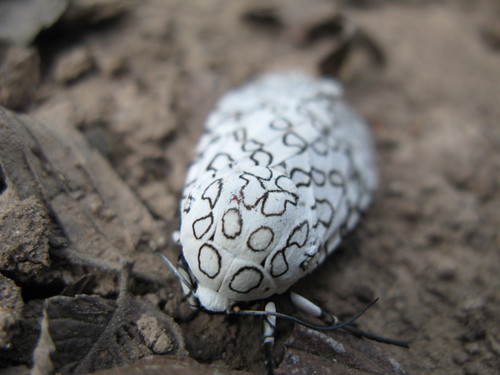
Buggin' Out on Thursdays :: The Giant Leopard Moth Does Not Say Meow

I found this moth on the trail of McKinney Roughs Nature Park (outside of Austin, Texas). It's a Giant Leopard Moth (Hypercompe scribonia), also known as an Eyed Tiger Moth. I'm not sure if he was hurt or just tuckered out but I didn't want to bother him aside from taking a quick photograph. Well, it's more like a portrait.

When I was little we used to spot a LOT of little hairy caterpillars in the herb garden or trying to cross the street (which always worried me). My family called them "woolly" caterpillars. I considered them the teddy bear of the caterpillars. Therefore, I liked them. Granted, there are a lot of fuzzy bear worms out there but if you ever see a woolly caterpillar it might just be a baby Giant Leopard Moth. Don't try to pick them up and snuggle them though because, while they look fuzzy and sweet, the bristles on the caterpillars can irritate the skin and cause a rash!

The abdomen of a giant leopard moth is orange and blue. I think of it as God's way of showing us that as soon as we think we are seeing it all "in black and white" there is often something lurking beneath. In this case, something good, and pretty, and surprisingly delightful.

To see the orange and blue enlightenment of a Giant Leopard Moth's six pack abs: click here to check out BugGuide.net!

What kind of bugs have you seen lately?

Kingdom Animalia (Animals)
Phylum Arthropoda (Arthropods)
Class Insecta (Insects)
Order Lepidoptera (Butterflies and Moths)
No Taxon (Moths)
Superfamily Noctuoidea
Family Arctiidae (Tiger Moths)
Subfamily Arctiinae (Tiger Moths)
Tribe Arctiini
Genus Hypercompe
Species scribonia (Giant Leopard Moth - Hodges#8146)