Showing posts with label bugs. Show all posts

Thursday, October 21, 2010

Oh Bugger :: What's Buggin' Out On Thursdays?


I'm a self-proclaimed naturalist researching the "bugs" in my life.  I use the term "bug" lightly and in very general terms so I include insects, spiders, and other related creatures.  I try to share a new bug every Thursday (but do not always get a chance).

My camera is a Canon Powershot G7.  As an amateur photographer simply pursuing what interests me, I've found that I truly enjoy taking photos of bugs and doing my best to identify them and learn more about their habitat and biology.
My Philosophy: To take photos of Texas wildlife and local insects in their environment without disturbing them or causing them harm.  My goal is to capture their likeness in a photograph, identify the specimen by research using credible internet resources, and share what I've learned with others.
Have you heard?  Buggin' Out On Thursdays has it's own index list including article titles, specimens, and dates published so you can find what interests you easily.

I often contribute my photos to the field guide at BugGuide.net and can be found there as biologie.

Thursday, August 26, 2010

Buggin' Out On Thursdays :: I've Got Spines but no Backbone

Spiny Orb Weaver by biologie-me.blogspot.com © 2010

The Spiny Orb Weaver, also called the spiny backed orb weaver, is known in Texas as a beneficial spider for the garden because they eat flies and mosquitoes.  A lot of people refer to these spiders as "crab spiders", however, they are actually orb weavers.  They make the beautiful circular spiderwebs that catch the morning dew. 

These little spiny spiders may look spooky but they are not considered dangerous.  While hiking in the woods outside Austin you may come across these guys in abundance!  They usually like to spin their webs in forested areas although they can be found anywhere - like on my canna lilies in my backyard where I found this one!  She would spin her web between the leaves of the lilies.  I visited her daily while I watered my flowerbed and missed her when she disappeared.

The spiny backed orb weavers have six pointed projections on their back, commonly referred to as "spines" and are very easily identified by this characteristic, as well as the patterned "face-shaped" coloring which can be white, yellow, orange, or red.  Some of these spiders have a white pattern with red spines. 


If you've been following my blog you may remember Peaches (a true crab spider) and my post on the Western Spotted Orb Weaver (also a true orb weaver like our little spiny backed friend).

  What kinds of bugs have you seen lately?

Thursday, August 19, 2010

I Saw Sawfly Larvae "Saw" :: Buggin' Out On Thursdays

© Hungry by biologie-me.blogspot.com

Alice would have a thing or two to say about these hungry munchers.  It  is a  Caterpillar Wonderland and the wild green vine is the complimentary buffet.  They may look like caterpillars but these are actually sawfly larvae.  

The sawfly is a mystery to most people.  The insect is part of the family of Hymenoptera and some species are considered "pests" because the larvae eat farmer's crops and damage foliage, eating the leaves outright (like mine) or eating the leaves from the inside-out.  

The adult sawfly can easily be mistaken for a wasp although they do not have stingers and do no harm to humans.  The female adult sawfly has a little "saw" called an ovipositor on her rear-end that she uses to cut open plant tissue and lay eggs inside.

I often use the leaves of my vine (which grows wild in my backyard near the fence-line during the spring and all throughout summer) to photograph my jewelry for sale in my Etsy shop because the leaves are a beautiful green and compliment a lot of my pieces:


Etsy
Biologie

Caterpillars and other insects love the vine and can devour large portions of it in a matter of hours.  This doesn't phase me a bit because the vine grows back as thick and pretty as ever within a few days to a week!  

Dr. Dave Smith, a sawfly expert, at BugGuide.net identified these "bugs" for me and also told me this vine is part of the Cissus family.  This is a host vine for my sawflies, whose scientific name is Ceratulus spectabilis.  Further research shows the plant is a native of Central Texas and is commonly known as Sorrel Vine (Cissus incisa).  It's a great vine to grow in my area because it has a high heat tolerance and can be used in place of ornamental ivy.  I love the idea of growing native plant species in my backyard as opposed to using imported exotics.

Apparently, sawfly larvae choose to ignore the rule about not crapping where you eat:
 POO! © biologie-me.blogspot.com

What kind of bugs have you seen lately?

Thursday, May 20, 2010

Buggin' Out On Thursdays :: I'm Molting! A Metamorphosis.


Today is Buggin' Out On Thursdays and this little grasshopper's outer skin is the star of the show!

Did you know grasshoppers molted and left a perfectly intact outer casing of their former self hanging around?  I never really thought about it until I found this skin casing hanging upside-down from one of my flower's stem.

Not only was that interesting enough for me but I also noticed the actual baby grasshopper very close-by trying to hide from me and my camera:


After a little research I found out more than I ever wanted to know about the way these insects metamorphose into adult grasshoppers.
  • As insects grow and develop, they molt at intervals, changing structures and their form. This process is called metamorphosis.
  • A number of insects undergo gradual (simple) metamorphosis, such as grasshoppers. With this type of metamorphosis the insect that hatches looks like the adult except for its smaller size, lack of wings, fewer antennal segments, and rudimentary genitalia.
    • After shedding the serosal skin, the newly hatched nymph is called the first instar. After each molt the instar increases by one so that the nymph consecutively becomes a second, third, fourth, and fifth instar. When the fifth instar molts, the grasshopper becomes an adult, as called an imago.
    Now you know more than you ever wanted to about those darn grasshoppers who chomp on all your plants and garden vegetables!  You remember my bug butt post about those bugs stuck in the mud?  Well, here's a picture of another bug butt - this time in the form of a molted skin casing.


    What kind of bugs have you seen lately?

    Friday, April 2, 2010

    Bluebonnets Tell Bees Which Flower To Pollinate :: Nature In Harmony!

    Last month I mentioned bluebonnets are the state flower of Texas:
    The very first bluebonnet I photographed in my backyard this year was very young and none of the flowers on the spike had been pollinated yet. You can see my blog post about the "baby" bluebonnet, here.

    How do I know if the blossom has been pollinated?
    When the bees pollinate the bloom, the white section in the center of the little "bonnet shaped" flower turns a pinkish-red. My blogger friend, Hali, mentioned she'd like to see the color change and I promised a photograph so today it's time to deliver!

    Here we go:

    Why the color change?
    Bees don't interpret colors the same way humans see colors. They see the world in colors of blues, greens, and ultra-violet light. They can also see oranges and yellows. They can't see the color red.

    Since bees can't detect the color red the flowers of the Bluebonnet have adapted to save energy and time for both the bees and the flower. The flowers want to be pollinated so they can produce a seed and continue the cycle of life. They bloom and present a pleasing flower of blue with a white (or yellow) center to attract pollinators. The bees can see the bloom no matter what the color, however, that center of white or yellow is the key attractant. As far as the bluebonnets are concerned, they want the bees to ignore a flower that has already been fertilized and move up to a flower on the spike with a white or yellow center (colors bees are attracted to and can "see").

    In a nutshell, the reason the center of the bloom changes color is to encourage the pollinators to move to a flower on the bluebonnet spike that still needs pollination.

    Nature in harmony!
    The way bees and flowers work together is called symbiosis. Symbiosis is a relationship between two organisms of different kinds which benefits both organisms. Yay!

    Go forth and bloom! :)

    Thursday, March 18, 2010

    Buggin' Out On Thursdays :: Mystery of the Bug Butts

    Found! Bug butts sticking out of some dried mud on a fence post has me stumped! What were they doing there? Are those wasps butts? Did they nestle in from the cold and get frozen in time? How bizarre!

    It's Buggin' Out On Thursdays!

    Here's a close-up (below) of one of them sticking out of the mud.

    What is it?

    What kind of bugs have you seen lately?

    Wednesday, March 17, 2010

    My Veggie Garden :: Attempt Two

    Photo: Raised Bed Veggie Garden © Biologie.

    My raised bed vegetable garden is now a total of 36 square feet. That's still small but at least I have a little more room to work with than I did last Fall. I planted my new Spring vegetable garden on Monday and tied a soaker hose along the top of the beds. After I had it all hooked up I realized it would have made more sense to line the soaker hose along the inside of the beds so I might re-do all that before the plants really start taking off.

    Last fall I planted a pesticide-free vegetable garden of mostly squash. My beautiful and healthy squash plants were devastated by squash vine borers. I even took a picture of one of the adult moths (pictured left) sitting on my squash leaf and wondered what kind of bug it was but I forgot to identify it, to my later chagrin.

    The vines went from thriving and blooming big gorgeous flowers to withered and dying, practically overnight. The squash plants had been attacked from within by the larvae of the squash vine bugs and I couldn't see the damage until it was too late! The adult female lays her eggs at the base of the plant and when the larvae hatch they burrow inside the stem and begin eating the plant alive from the inside! After they are finished with the buffet, they exit the stems and work their way into the ground to pupate and emerge the next spring to start the cycle all over again.

    To manage the menace of squash vine borers, the first step is to know what the adults look like and keep an eye out for them. Organic controls are outlined at the National Sustainable Agricultural Information Service: Squash Bug and Squash Vine Borer.

    I'm spraying the new transplants with a home-made organic pepper spray recipe my dad uses on his garden. I'm not sure if it will keep the borers at bay but it does help keep off the bugs that like to chomp the leaves.

    Organic Pepper and Garlic Spray

    Ingredients:
    • dishsoap
    • several cloves of garlic
    • 6-10 hot peppers (hotter the better!)
    • 1 gallon water
    Directions:

    Place garlic, peppers and a small amount of your water in a blender/food processor and puree. NOTE: Avert your face when you take the lid off because the fumes are very strong. Strain the mixture and add the liquid to your gallon of water.

    When you are ready to use the solution on your garden, fill up a spray bottle, add 2 tsp dish soap, shake and spray every few days on the tops and undersides of plants and leaves until the pests are under control.

    Shake well before each use.

    Here's my newly planted Spring 2010 Veggie Garden!
    My Spring 2010 Veggie Garden Mosaic
    Wish me luck and Happy Saint Patrick's Day!

    Thursday, March 11, 2010

    Buggin' Out On Thursdays :: A Little Side Tour

    It's Buggin' Out On Thursdays!

    Buggin' Out is a weekly blog post about the creepy crawlies in my life. I like bugs and love to take macro photos of the ones I find in my backyard (and occasionally a few home invaders like Peaches The Crab Spider). I try my best to identify and research the insects I photograph and share all the Bug Wonderfulness with you. It's a virtual bug collection! This house is a no squish zone and most pests are "released back into the wild", i.e., moved outdoors using the glass jar, paper magazine technique of which I am an expert at these days!

    Today, I'm going off the grid a little bit. The theme is still bugs, of course, but these are made of metal. My mom and dad gave me a little basket of goodies for Valentine's Day which included a cute bee and butterfly tea light holder set plus a heavy iron FLY! I named him Frederick and he's currently my most favorite paperweight of all time. I thought it was cute that my mom picked these out for me in lieu of my new hobby and this weekly blog series.

    Frederick The Iron Fly

    What kind of bugs have you seen lately?

    Thursday, March 4, 2010

    Buggin' Out On Thursdays :: Crabby Spider Promises She's Not Shelob's Sister

    Peaches The Ground Crab Spider
    Xysticus species

    "Don't squish me! I look wicked like Tolkien's Shelob but I'm not interested in biting you or Frodo!"

    I was sweeping the kitchen floor the other day when I looked down at my little pile of dirt and spied a very creepy looking spider. A little yelp of surprise escaped from my lips and I went into fight or flight mode for a second but the spider just sat there quietly. From my vantage point I thought it might be a Mutant Giant Tick like one you'd see in an old Sci-Fi Flick! Yikes. Then I thought maybe she was Shelob's baby sister. Again, yikes.

    Once I figured out the "thing" wasn't going to come skittering after me like a ravenous monster it didn't take long before I had slipped a sheet of paper under her and placed a glass jar carefully over her so I could get a closer look. The spider remained very still. Not long after that and I had removed the jar and started taking macros so I could run to BugGuide.net and see what everyone thought about my new "bug".

    Mandy at BugGuide was very helpful - she's Spiderwoman! She mentioned the star of today's blog post is a spider whose species has not yet been identified in the guide. My spider and the rest of her species are a uniform peachy red (in low light she may even look brownish until you get her out in the sun). I learned the only way to truly identify a spider at the species level is to have an entomologist study the adult spiders "private parts". The appropriate term for this on a female spider is the epigynum (to learn more check out this short article at Museum Victoria). I sure wish I had taken some underbelly shots of my buddy, Peaches, so I could help identify her species for the guide. Maybe next time!

    Here are four fast facts about ground crab spiders:
    • They are not poisonous to humans
    • They aren't normally found in the home and hunt outdoors
    • Rather than spin a web, they lay in ambush for prey to pass by
    • Crab spiders can walk forwards, backwards, or sideways - just like a crab!
    It's Buggin' Out On Thursdays!

    What kind of bugs have you seen lately?

    Thursday, February 25, 2010

    Buggin' Out On Thursdays :: Egypt Isn't The Only Place For Green Metallic Scarabs!


    A beautiful metallic green beetle known as the Fig-eater Beetle or June Beetle (Cotinis mutabilis) (Cotinis nitida) is one of the scarab beetles of Texas. Only three species of this type of beetle are found in Texas and this guy was crawling on my flagstone patio in a great hurry to get somewhere. Under those two plates of "metal" are the wings of the scarab. This beetle reminds me of a little inch long mini-tank. The above is the only photo I was able to take of him so I'm also sharing a really awesome shot of one from ThreadedThoughts on Flickr:

    June Bug by ThreadedThoughts

    These beetles are known by fruit farmers as pests because of their love for thin-skinned fruits like figs, peaches, apricots, nectarines, plums, and grapes. They don't have powerful jaws so they can't bite into any thick-skinned fruits (including your fingers). You can pick them up and hold them if you are so inclined. They are harmless to humans but due to their plump bodies they tend to fly in a haphazard manner so it's easy to have one bean you in the head if you aren't paying attention!

    What kind of bugs have you seen lately?

    Thursday, February 18, 2010

    Buggin' Out On Thursdays :: A Green Lynx Spider Pounces Into The Virtual Bug Collection


    It's Buggin' Out On Thursdays and I love this pretty spider! Yes, I think he's pretty. Greens, yellows, black polka dots, and crazy wicked looking hairy bristles on the legs. Awesome.

    Green lynx spiders (Peucetia viridans) are a very welcome addition to my gardens. One little green spider up close in the macro lens brings a whole new world to life! I never knew this guy had transparent yellow legs with black spikes! I found my little buddy living in the foliage of my squash plants waiting for prey. I get these spiders in my gardens every year.

    Like most anybody, green lynx spiders will bite you if provoked but are generally harmless to humans. Interestingly, in addition to injecting venom into their prey with their fangs they are capable of spraying venom from them as well. They eat insects that destroy crops like moths who feed on cotton. Unfortunately they don't discriminate if a bee or other beneficial pollinator happens to come around while they are hunting.

    These spiders hunt during the day and roam low foliage, herbs and shrubberies. They can "pounce" on their prey when they come across something worth eating. They don't have a web but they can spin silk and use it as leverage or as a safety line when moving from one plant to another.

    The species name, viridans, is Latin for "becoming green". The spider inspired me to make these earrings entitled "Green Lynx. Love Her. A pair of Peucetia viridans earrings" and they are part of my Mother Earth Collection @ Etsy.


    They'd be wonderful for St. Patty's Day, yes? Unless of course you like getting pinched!

    Buy the earrings here!


    Monday, February 15, 2010

    Mosquito Game :: Be A Vector And Bite The Humans!


    Become Speedy Ann, an Anapheles mosquito whose flight you control past obstacles, hungry birds, and insecticides so you can bite humans, give them Malaria, and use their blood to produce new eggs.

    The first time I played the Mosquito Game I had a hard time figuring out the controls and immediately got eaten by a bird. Starting again, I found a human, hovered over him (a blue or orange dot) and started trying to settle down to take my blood meal (have to press and hold the space bar to "eat") when he noticed me and smashed me dead. The game had me laughing. Try and get the High Score by being the fastest mosquito to drink enough blood to produce eggs!

    Play the game at NoblePrize.org: Mosquito Game

    Fast Facts:
    • Malaria is caused by a parasite, Plasmodium species.
    • Usually, people get malaria by being bitten by an infective female Anapheles mosquito. Only Anopheles mosquitoes can transmit malaria and they must have been infected through a previous blood meal taken on an infected person.
    • Once a mosquito ingests malaria parasites from an infected human, the parasites must undergo development within the mosquito for about 10-21 days before they are infectious to humans.
    • The mosquito Anapheles gambei is the main vector of malaria.
    • Each year 350-500 million cases of malaria occur worldwide, and over one million people die, most of them young children in Africa south of the Sahara.
    • From the CDC website:
    "Some Anopheles species are poor vectors of malaria, as the parasites do not develop well (or at all) within them. It is hoped that some day, genetically modified mosquitoes that are refractory to malaria can replace wild mosquitoes, thereby limiting or eliminating malaria transmission."

    Thursday, February 11, 2010

    Buggin' Out on Thursdays :: The Giant Leopard Moth Does Not Say Meow

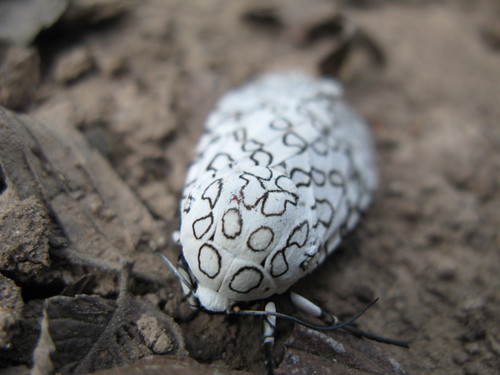
    I found this moth on the trail of McKinney Roughs Nature Park (outside of Austin, Texas). It's a Giant Leopard Moth (Hypercompe scribonia), also known as an Eyed Tiger Moth. I'm not sure if he was hurt or just tuckered out but I didn't want to bother him aside from taking a quick photograph. Well, it's more like a portrait.

    When I was little we used to spot a LOT of little hairy caterpillars in the herb garden or trying to cross the street (which always worried me). My family called them "woolly" caterpillars. I considered them the teddy bear of the caterpillars. Therefore, I liked them. Granted, there are a lot of fuzzy bear worms out there but if you ever see a woolly caterpillar it might just be a baby Giant Leopard Moth. Don't try to pick them up and snuggle them though because, while they look fuzzy and sweet, the bristles on the caterpillars can irritate the skin and cause a rash!

    The abdomen of a giant leopard moth is orange and blue. I think of it as God's way of showing us that as soon as we think we are seeing it all "in black and white" there is often something lurking beneath. In this case, something good, and pretty, and surprisingly delightful.

    To see the orange and blue enlightenment of a Giant Leopard Moth's six pack abs: click here to check out BugGuide.net!

    What kind of bugs have you seen lately?

    Kingdom Animalia (Animals)
    Phylum Arthropoda (Arthropods)
    Class Insecta (Insects)
    Order Lepidoptera (Butterflies and Moths)
    No Taxon (Moths)
    Superfamily Noctuoidea
    Family Arctiidae (Tiger Moths)
    Subfamily Arctiinae (Tiger Moths)
    Tribe Arctiini
    Genus Hypercompe
    Species scribonia (Giant Leopard Moth - Hodges#8146)

    Thursday, February 4, 2010

    Buggin' Out on Thursdays :: Western Spotted Orbweaver Spider joins the Virtual Bug Collection


    Don't be scurred. I'm beneficial!

    On a breezy Fall day I grit my teeth and try not to freak out while I bend, stretch, and strain to take photographs of the black spotted yellow spider bouncing on it's web in the gusts of wind.

    Large spiders are pretty high on my freak-out factor but I suppose my love of life, nature and - well, bugs - transcend any major squeamishness as long as I'm just photographing. Finding a spider crawling on me is an entirely different matter and ends up in the dance otherwise known as "arachnid-induced flailing with various shouts and high pitched yelps of surprise" until it is flung off (hopefully unharmed)! That particular dance is exactly what I would have done if this spider jumped off it's web onto my camera. Luckily, these types of spiders are shy and their bite may be painful but it's non-toxic to humans. I understand that they will bite you if harassed (and in that case I don't blame them one bit)!

    I found this spider making her web low to the ground in the afternoon by my honeysuckle vine. I went out to check on her a few days later and she was hiding up in the leaves of the honeysuckle. She was still attentive and attached to a new web with a little line of silk, waiting for prey. I guess she thought more bugs would get caught in her net if she hid on the side of the web rather than right smack in the middle.

    With the help of the ID Request feature on BugGuide.net I found out my spider is a Western Spotted Orb-weaver, Neoscona oaxacensis, and is indeed female. Apparently males don't have such bulbous bootys. A famous female weaver of the orb is Charlotte from the book Charlotte's Web by American author E. B. White. My mom used to read this to me and it is a beloved book from my childhood. Doing a little research I found out that Charlotte is a barn orb-weaver spider known as Araneus cavaticus.

    Gorgeous big round spiderwebs spun in what is commonly thought of as the classic spiderweb shape are made by orb-weavers. A fitting name! If only I had taken a picture of the pretty round spiderweb in the morning, dripping with dew.

    Interestingly, some orb-weavers do not build webs at all but instead dangle a sticky globule on a strand of silk from their front legs. The glob is covered in a scent to attract male moths which come looking for a female and instead find themselves bitten and subsequently eaten. Yikes!

    What kind of bugs have you seen lately?

    Thursday, January 28, 2010

    Buggin' Out on Thursdays :: Bee Flies for the Virtual Bug Collection

    Bee fly drawing copyright © 1996 by Louise Kulzer

    Eating larvae and sipping nectar is a way of life.

    It's a bee? It's a fly? It's a bee fly!


    It's also Buggin' Out on Thursdays.

    When my husband and I celebrated our wedding anniversary a couple years ago, we stayed at the Lost Pines Resort and Spa outside of Austin, Texas. The resort has a small butterfly garden. Even though it was nearing the end of September there were still flowers in bloom and insect activity. I was mesmerized by a little fuzzy buzzy "bee" sipping the nectar of yellow wildflowers.

    After checking out BugGuide.net (a site where naturalists post and identify bug photos) I tracked down my "strange little bee" and found out it's actually related to flies and is, in fact, a true fly which mimics a honeybee so as to ward off predators.

    It has a plump, fuzzy body with stripes of (sometimes) brown and yellow. The species I captured in my photos has a long proboscis with which to reach nectar. There are different types of bee flies and the Family name for them is Bombyliidae. Their name reminds me of Tom Bombadil from J.R.R. Tolkien's writings!

    They have been called the Harbingers of Spring. The early "bee fly" gets the "worm", so to speak, because these insects get busy at the very beginning of Spring to lay their eggs near the eggs of beetles, bees, wasps, butterflies, moths, or on eggs of grasshoppers. The bee fly larvae hatch first, have a chance to mature a bit, and when the host egg hatches our little buddy has something good and nutritious laying within easy reach!

    If you think you spot a bee fly I hope you have your camera ready because they hover and dart. They are much faster than true bees. They remind me of hummingbirds! I had trouble following this little one around with my camera because she was so speedy. I love the way her back legs trail behind her as she zips to the flowers!

    If you have a bug story, blog post, or photo you'd like to share leave a comment and add to the Virtual Bug Collection!


    What kind of bugs have you seen lately?


    Thursday, January 21, 2010

    Buggin' Out on Thursdays :: A Virtual Bug Collection

    Butterfly Cocoon - Lost Pines Resort Butterfly Garden

    Apparently, based off all the photographs of insects and bugs and other creepy crawlies I've collected over the last few months, I like bugs! I hadn't really noticed how often I find and snap pictures of little bugs and spiders until I started sorting through all the photos stored in my camera.

    I love the picture of this butterfly cocoon (above). It was taken at the Hyatt Regency Lost Pines Resort and Spa outside of Austin, Texas when my husband and I were there to celebrate our wedding anniversary. The resort is wonderful and we spent a lot of time hiking and swimming but also squeezed in time for kayaking down the river!

    I'm blogging my collection of bugs starting every Thursday with photos and a few interesting tidbits about each specimen in my "virtual" bug collection. I guess I prefer collecting bugs via photos rather than to euthanize them, stick a pin through them, and mount them in a glass case!

    Here is a preview of what is to come: